
Written by
Reviewed by William Cooper
Follow us
Did you know that between March 2024 and March 2025 there were over 245,000 reported burglaries in England and Wales alone?
If you’re looking to improve your home security, or you’re shopping for insurance and want to understand how security upgrades might impact your premiums, you’re in the right place.
In this article, we are going to share some simple home security tips to help keep your high-value home safe.
Key takeaways
- Home security tips for when your home is unoccupied
- Create a home security checklist
- How does home security affect insurance
- Home security FAQs
Home security tips for when your home is unoccupied
Holidays are supposed to relieve stress, not create it. The last thing you want to be worried about when you’re going on holiday is your home security. Here are our top tips for making your home less of a target for opportunistic burglars.
1. Invest in an alarm, smart security system or CCTV
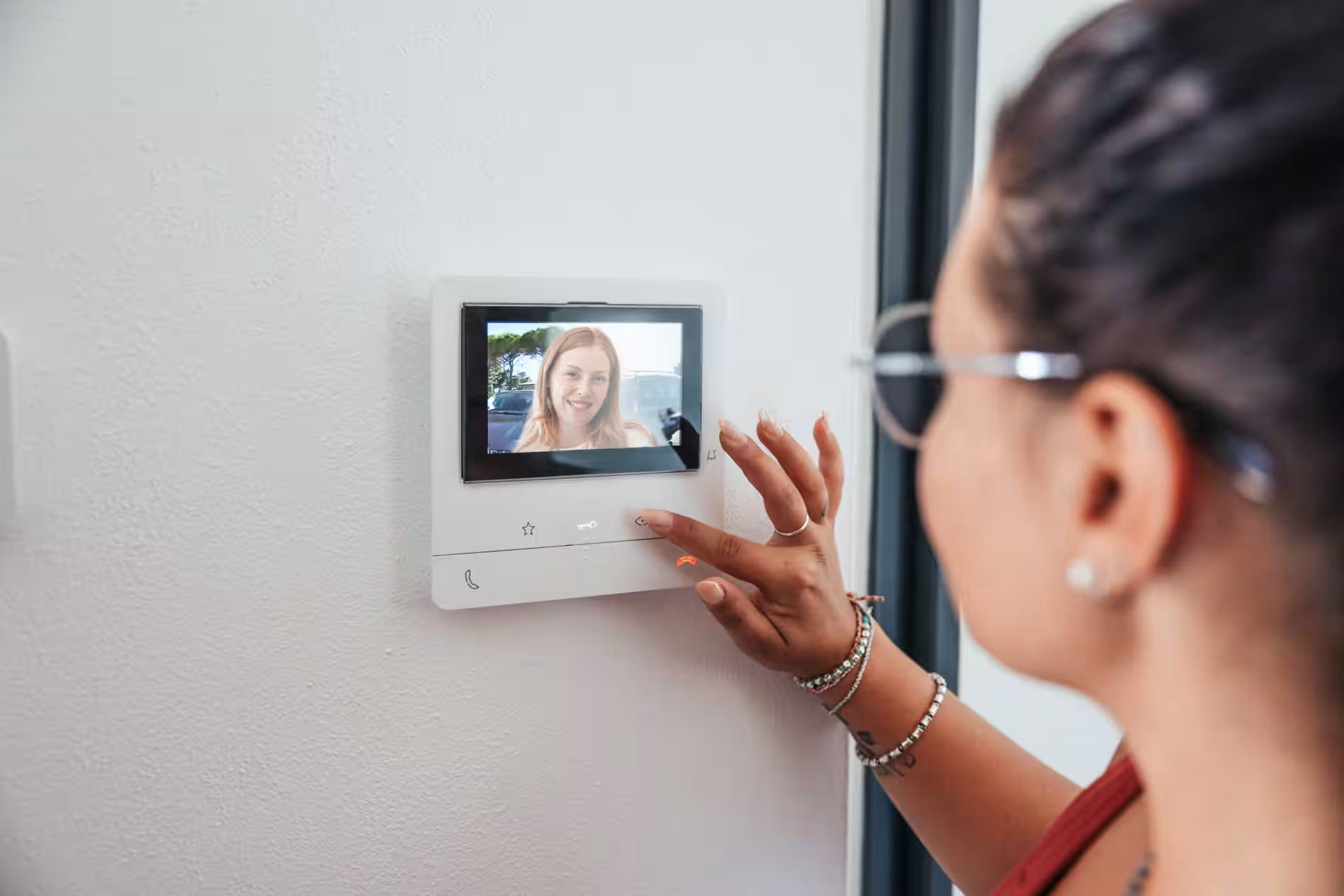
One sure-fire way to improve your home security is to install a burglar alarm or a smart security system. One study, conducted by the Home Office, revealed that 60% of burglars wouldn’t target homes with a security alarm.
Not only do they act as a deterrent, but CCTV footage can also significantly help your insurance claim, as the footage can be used as evidence. Try to position CCTV cameras to cover potential entry points such as doors and windows.
Some of the more advanced home security systems on the market also have the option of 24/7 monitoring, which provides round the clock protection and quick response time if triggered.
2. Implement tactical lighting
Light can be a powerful deterrent. There are a couple of ways you can use it to your advantage and make your home more secure.
First, you can use it to light up the darker areas of your property where opportunistic burglars might try to enter the premises. Motion-activated lights can also prove useful while also being energy-efficient.
Another option is to invest in timer-controlled lamps for inside your home. These can be set up to turn on and off at different times to give the impression that someone is home when you’re away.
3. Secure your garden
Dark and concealed gardens are a common place for burglars to slip in unnoticed. Make sure to protect your garden and outbuildings when you go away by locking gates and storing away any ladders or tools that can be used by thieves to gain access to the higher floors.
As mentioned above, install motion sensors to help improve visibility. You can also make your garden less accessible by planting prickly shrubs or putting up tall fences.
4. Hide all valuables
Burglars are always on the lookout for easy targets with the potential for high rewards. Make sure you don’t leave any valuable items or money on display like money, electronics, jewellery or watches. Keep your curtains and blinds closed to prevent thieves peeking through and treating your living room like it’s a catalogue.
Any valuable items should be stored in an insured-rated safe, which you can learn more about here.
5. Invest in strong locks
This recommendation doesn’t just protect your home, but also your insurance policy. Upgrade locks on all your doors and windows to meet the British Standard requirement. Failing to do so, could result in your claim being rejected following a break-in.
6. Make your home look occupied
Ask a family member or trusted neighbour to help give the impression that someone is home while you’re away. Timer-controlled lamps can be useful here, but unfortunately, they can’t stop simple giveaways like overflowing mail, or bins sitting on the street for days after the collection day. If it’s been snowing, ask your trusted helper to clear your path or walk across the snow to give the illusion someone has been there that day.
7. Avoid posting holidays on social media
Be careful what you share on social media, especially if your profile is public. One study revealed that over 75% of convicted burglars admitted they used social media platforms to aid their planning. Instead of posting in real-time, share highlights when you return from the trip.
Create a home security checklist
Before your next trip away, make a to-do list to reduce the risk of forgetting something as you dash out the door to the airport.
Here are a few ideas to get you started:
- Test security cameras, alarms and smart sensors to ensure they are working properly
- Test all external lights and replace any failed bulbs
- Lock all doors, windows and outbuildings
- Ensure that the garden is fully secure
- Cancel or divert any parcel deliveries and regular post where possible
- Set timer schedules for several rooms, not just one. Make sure to test the timer-controlled switches ahead of time to reduce the likelihood of a technical fault
- Ask a trusted family member or neighbour to check in on the house while you’re away. Give them your phone number in case of emergencies
How does home security affect insurance?
Improving your home security can have a direct impact on your insurance. Insurers may be more likely to insure your property if certain precautions have been taken to mitigate risks. They may also charge lower premiums as they view your property as less of a risk.
In addition to this, some insurers may agree to insure you on the condition that some of the above measures are met. For example, installing British Standard locks.
Home security FAQs
I have a holiday home in the UK. How do I make it secure when I’m away?
Which houses do burglars avoid?
Final thoughts
By implementing the home security tips in this guide, you can make your home much less appealing to burglars. Not only does this help protect your property and its contents, it can also work in your favour when you’re arranging high value home insurance. If you have any questions, or you’d like to arrange a quote, speak to a member of our team.
Get a quote now
Huge attention to detail and a can-do approach made this an unusually good experience in buying insurance
5 Star Review ReviewsIO
Written by Matthew Ashton
I started working in the insurance industry in 2004. Four years later, I left to focus on theological studies, working as a youth worker and then as a ministry director in Seattle, USA. When returning to the UK, I had an opportunity to work for the late Andrew Marchington. I joined his firm as a sales advisor when it had around ten staff members. Within three years, I was Head of Ops with a staff team of over 30 people. After a chance encounter in 2019 with Rachel Living and Will Cooper, I co-started Stanhope to build a high-value home, luxury watch, and jewellery broker synonymous with trust. I love being with Donna, my wife, and four kids when not working, cramming in the odd row, or run when I can. I am fortunate to love what I do and consider it a blessing to grow the Stanhope brand.